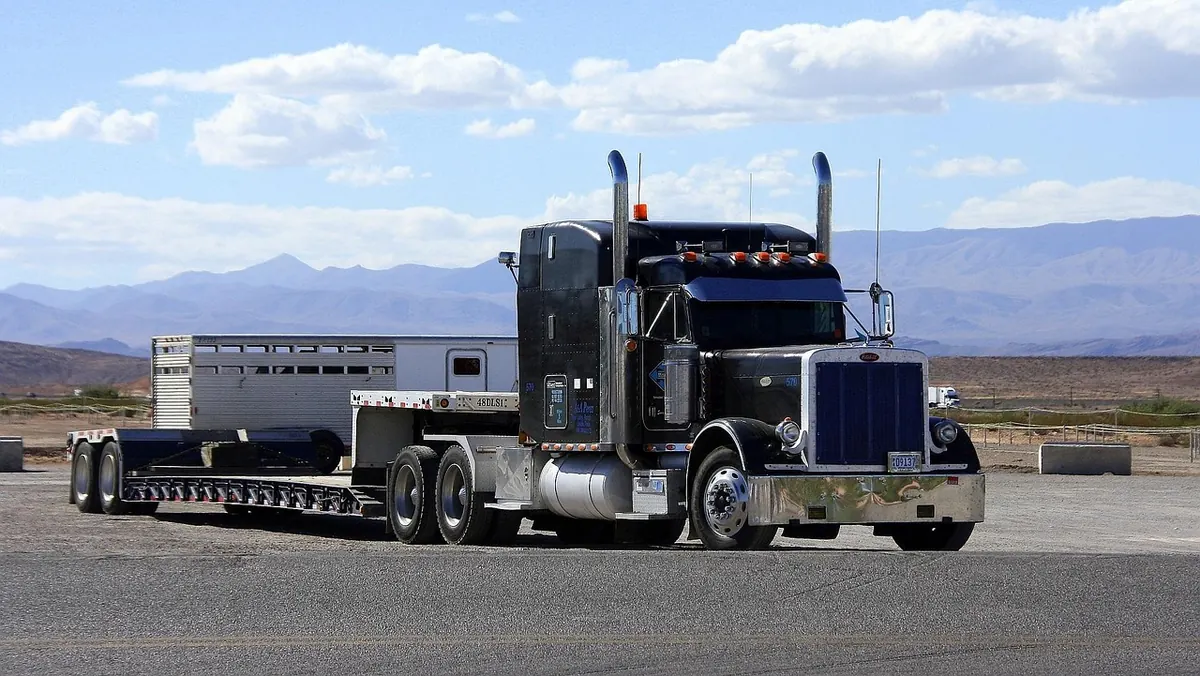
A flatbed hides nothing. There's no box to swallow a sloppy load and no doors to close on a mistake. Everything you do — or forget to do — is visible to the scale house, the inspector at the roadside, and the driver behind you when something lets go. That's part of why flatbed work pays better than a lot of dry van freight, and why it punishes shortcuts so fast. The errors below are the ones that keep showing up in the same paperwork: an overweight citation, a claim for dented steel, a strap that failed two hundred miles from the shipper.
Weight distribution: the mistake you can't hide
Load placement decides how the truck steers, brakes and scales, and it's the first thing an inspector looks at. Two mistakes cause most of the trouble here.
1. Loading heavy at the rear
Shift too much weight behind the trailer axles and you unload the steer axle. The truck feels light and vague in the wheel, braking distances stretch, and a hard crosswind at 60 mph becomes genuinely unpleasant. Keep the heaviest portion of the load centred over the trailer's axles or slightly forward of centre, so the tractor keeps its grip. As a starting point, many drivers aim for a front-to-rear split on the trailer axles of roughly 60/40, then adjust from the scale ticket rather than from instinct.
2. Guessing instead of weighing
A deck that took the load last week may not be legal this week. Different fuel levels, different pallet weights, a heavier fifth-wheel setting — the numbers move. Get a scale ticket on anything you're unsure about, and know your limits: steer axle, drive axles, trailer axles, and gross. Watch for concentrated loads too. Coils, machinery, and steel plate sitting on a small footprint can exceed a deck's point-load rating even when the total weight looks fine. Use coil racks, spreader bars, or blocking to spread the load out. Bridge-formula restrictions and axle limits vary by jurisdiction, so confirm the current rules for every state or province you'll cross.
Securement: where most fines start
Securement is a system, not a pile of straps. The common failures are predictable:
- Too few tie-downs. A reasonable baseline is two tie-downs for cargo up to about five feet in length, then roughly one more for every additional ten feet. Long loads need more than a driver's gut feeling.
- Ignoring working load limits. Add up the aggregate working load limit of every tie-down and compare it to the cargo weight. Half the cargo weight is a common minimum baseline for unblocked freight — check the rules that apply to you rather than assuming.
- Bad angles. A strap running nearly vertical or nearly flat contributes almost nothing to stopping sideways movement. Aim for a tie-down angle that pulls the load down and into the deck.
- No re-check. Load settles, straps slacken, chains rattle loose. Stop and check after the first fifty miles, then again at every fuel stop and every break.
Also remember that friction alone is not securement. A rubber-backed mat helps, but it doesn't replace straps, chains, or blocking. And if a ratchet or binder needs a cheater bar to lock down, something is wrong with your setup.
Edge protection and hardware
Straps and chains die at sharp corners. A steel flange, a bundle of angle iron, or a rough casting will saw through webbing in a few hundred miles, and the load that comes loose afterward is your problem, not the shipper's. Use corner protectors, sleeves, or a scrap of heavy rubber every time webbing crosses a hard edge. Chains over aluminium, painted panels or polished product need padding too, or you'll be filing a damage claim before you've left the yard. Inspect your gear as you use it: a strap with a cut, a frayed edge, or a knot is a reject, not a spare. A strap with a knot in the webbing loses a large part of its strength, so cut the knot out and shorten the strap properly.
Tarping done badly
Tarping is where a lot of good loads get spoiled in the last ten minutes.
The order matters. Secure the load first, so the tarp sits on a stable surface, then tarp, then run your final straps over the top. Tarps that go on before the load is tied down end up pinched between cargo and deck, and they tear at the first bump. Leave drainage in mind — a tarp that collects a puddle will sag, flap, and eventually split.
Wind is the other enemy. A loose tarp edge at highway speed whips itself to shreds and can be a hazard to other traffic. Use enough straps over the tarp to hold it flat, and don't run a tarp over hot exhaust components or sharp corners without a barrier. If the customer has a tarp specification — steel often needs protection from rain, insulation and some building products need full coverage — get it in writing on the paperwork rather than taking a dispatcher's word for it.
Documentation and permit errors
Paperwork is boring right up to the moment it costs you a day at a scale house. A bill of lading that describes the freight as "machinery" tells an inspector nothing and tells your insurer nothing when a claim arrives. Ask for a specific description, piece count, and weight. Keep your weight tickets, and know whether the load is oversize or overweight before you leave — permits, pilot cars, and route restrictions are on you, not the shipper.
Photograph the load before you pull out: wide shots, close-ups of every tie-down, the placard or tarp, and the trailer number. Photograph it again at delivery. If the receiver notes damage, get it written on the delivery receipt at the time of delivery, with a signature. Claims disputed weeks later rarely go well.
Rules for permits, oversize loads, and hazardous materials vary widely by jurisdiction and change from time to time. Confirm current requirements with your carrier's compliance staff or the relevant transport authority before you roll.
A pre-departure routine that catches all ten
None of this is difficult. It's just easy to skip when you're late. Build one habit instead, and run it the same way every time:
- Look at the load from the side and the rear. Does the weight sit where it should?
- Check the scale ticket against every axle limit.
- Count your tie-downs and confirm the angles and aggregate capacity.
- Walk the edge protection on every strap and chain.
- Confirm the tarp spec, then strap it down so it can't flap.
- Photograph everything and read the paperwork once more.
- Re-check the whole load after fifty miles.
Ten minutes on the ground beats an hour on the shoulder. Flatbed work rewards drivers who treat every load as if the next mile is the one that matters — because eventually, it is.
Photo: nockewell1 / Pixabay